


The power of diversification
Finding the right balance of risk and return is a constant challenge in investing; diversification can be an effective tool to strengthen outcomes.

Studies dating back to the 1950s1 indicate that diversification can reduce volatility while aiming for better long-term results. Over time, asset allocation has been shown to explain much of the divergence in portfolio performance.2
Many eggs, multiple baskets
While risk is inherent in investments, it doesn't mean we should blindly take on additional risks to enhance our investment returns. Every asset class has its own risk and reward characteristics; they perform differently depending on the point of the economic cycle.
By putting different asset classes together in one portfolio, the variability of each asset class will matter less, while the overall portfolio volatility will be reduced.
So, does this mean we should put as many asset classes as possible into one portfolio?
On the contrary, asset allocation is the process of constructing the optimal investment portfolio, with different asset classes and weightage, according to an individual‘s investment objectives and risk tolerance. The portfolio should then maximize returns for the individual’s level of risk tolerance. This whole process is akin to allocating an optimal amount of eggs within different combinations of baskets.
Simply put, investing in a single asset is typically insufficient to meet investment objectives. But by expanding the investment universe from a single asset to different asset classes and from local to international markets, the risk of over-concentration in a single asset is reduced.
Calendar year returns of different asset classes3
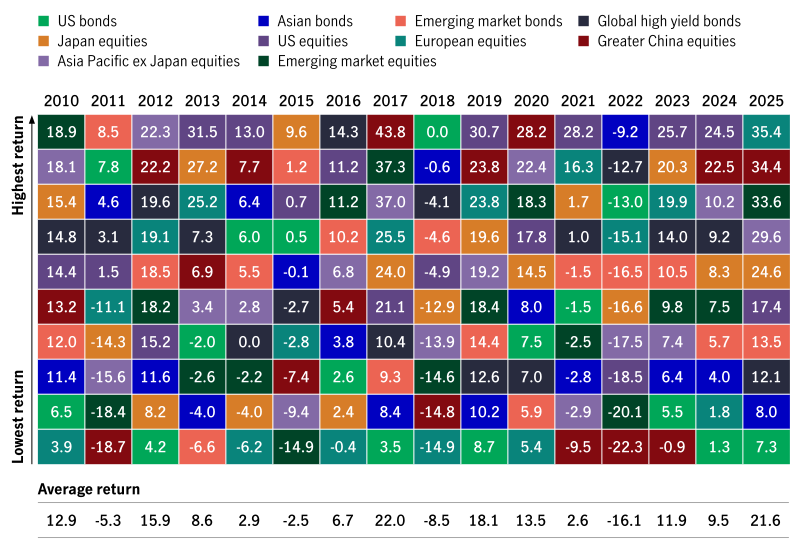
For illustrative purposes only. Diversification or asset allocation does not guarantee a profit or protect against the risk of loss in any market.
The five Rs of asset allocation
So, how should one go about diversifying and allocating assets? For a start, investors can consider the 5Rs: risk, return, right mix, rebalancing and review, which are the essence of asset allocation.
1 Risk: knowing your risk tolerance
Our needs change as we go through different life stages, and it's important to understand and evaluate our unique risk tolerance. In general, young investors usually have more time on their side and can tolerate higher risk, while middle-aged investors face greater financial pressures and can tolerate only moderate risk. Senior investors, on the other hand, lack stable sources of income and should therefore focus on capital preservation.
2 Return: setting expected income objectives
Before constructing the portfolio, investors should also consider their expected returns, as this would largely influence the asset allocation.
3 Right mix: portfolio construction
When it comes to constructing a portfolio, investors are essentially making decisions on how to allocate their capital among different asset classes in a way that maximizes the potential of investment returns, while ensuring that it fits the unique risk profile.
Key areas to consider would include: the associated investment risks, what the investment can do for you, what to invest within each asset class, and the right manager for your portfolio.
4 Rebalancing: disciplined portfolio management
After a portfolio is established, should investors hold on to it without giving it much thought?
This is one common mistake to avoid; after all, markets are subject to fluctuations, and different asset classes perform differently depending on the market cycle. If left unmonitored, the initial weighting of the asset classes can change over time, resulting in a portfolio that may not be in line with the intended risk profile.
Therefore, portfolios should be rebalanced in a disciplined manner. When asset allocation weightings deviate from the initial asset mix (i.e. too high or too low), adjustments should be made. Better-performing assets may be sold to fund the purchase of underperforming assets at low price points, maintaining the original allocation weightings of the portfolio.
This risk management mechanism of “buying low, selling high” also instills discipline within investors by getting them to stay within their risk tolerance, instead of drifting away from their intended asset allocation. The asset allocation should be examined regularly, be it monthly, quarterly or annually. Deviations from the target allocation should be rebalanced to restore the target weighting.
5 Review: choosing investment products and managers wisely
It is also important to evaluate your needs or changes in financial goals depending on the current stage in life and adjust asset allocation accordingly. One good practice is to review the past performance of various asset classes in your portfolio to determine whether they've met their investment targets.
What’s more, work with the right investment manager. Choose your manager wisely by evaluating the performance, philosophy and risk control principles.
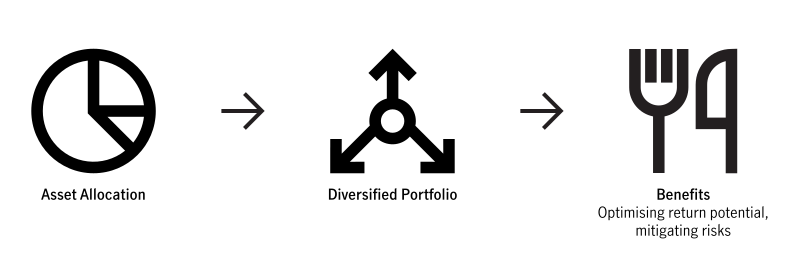
The pathway to diversification
1 Nobel Memorial Prize in Economic Sciences recipient Harry Markowitz popularised the concept of “diversification” and “asset allocation” in 1952. (http://www.nobelprize.org/nobel_prizes/economic-sciences/laureates/1990/press.html). 2 Financial Analysts Journal: “Determinants of Portfolio Performance” (May/June 1991); “Determinants of Portfolio Performance II: An Update” (Jan/Feb 1995); “The Equal Importance of Asset Allocation and Active Management”. March/April 2010. 3 Data source: Bloomberg, Manulife Investment Management, data as of December 31, 2025, total returns in US dollar. US bonds are represented by Bloomberg Barclays US Aggregate Index. Asian bonds are represented by 50% JPMorgan Asia Credit Index + 50% Markit iBoxx Asian Local Bond Index (prior to 2013: 50% HSBC Asian Local Bond Index). Global high yield bonds are represented by Bloomberg Global High Yield Corporate Bond Index. Emerging market bonds are represented by JPMorgan EMBI Global Core Index. Japan equities are represented by MSCI Japan Index. US equities are represented by S&P 500 Index. European equities are represented by MSCI Europe Index. Greater China equities are represented by MSCI Golden Dragon Index. Asia-Pacific ex-Japan equities are represented by MSCI Asia-Pacific ex-Japan Index. Emerging market equities are represented by MSCI Emerging Markets Index. Average return refers to the calendar-year average returns of the 10 asset classes listed above. Past performance is not indicative of future performance.
Important disclosures
Important disclosures
The material contains information regarding the investment approach described herein and is not a complete description of the investment objectives, risks, policies, guidelines or portfolio management and research that supports this investment approach. This commentary is provided for informational purposes only and is not an endorsement of any security or sector. The opinions expressed are those of the author(s) and are subject to change without notice. These opinions may not necessarily reflect the views of Manulife Investment Management or its affiliates. The information in this document including statements concerning financial market trends, are based on current market conditions, which will fluctuate and may be superseded by subsequent market events or for other reasons. This material does not constitute an offer or an invitation by or on behalf of Manulife Private Wealth to any person to buy or sell any security. Past performance is no indication of future results. The information and/or analysis contained in this material have been compiled or arrived at from sources believed to be reliable but Manulife Investment Management does not make any representation as to their accuracy, correctness, usefulness or completeness and does not accept liability for any loss arising from the use hereof or the information and/or analysis contained herein. Neither Manulife Private Wealth or its affiliates, nor any of their directors, officers or employees shall assume any liability or responsibility for any direct or indirect loss or damage or any other consequence of any person acting or not acting in reliance on the information contained herein. Please note that this material must not be wholly or partially reproduced.
Manulife Private Wealth is a division of Manulife Investment Management Limited. Investment services are offered by Manulife Investment Management Limited. Banking services and products are offered by Manulife Bank of Canada. Wealth & Estate Services are offered by Manulife Investment Management Limited. Manulife, Stylized M Design, Manulife Private Wealth, Manulife Private Wealth & Design are trademarks of The Manufacturers Life Insurance Company and are used by it, and its affiliates under license.
MPW 5311539